|
This page provides up to date details of any alterations to speakers etc. although these will also be in the weekly News Letter. More importantly it shows some summaries of past talks, events and outings made to and by the forum. It shows the wide variety of talks and activities carried out by our members and should be read in conjunction with the talks and other activities pages. We hope you will find it of interest.
0 Comments
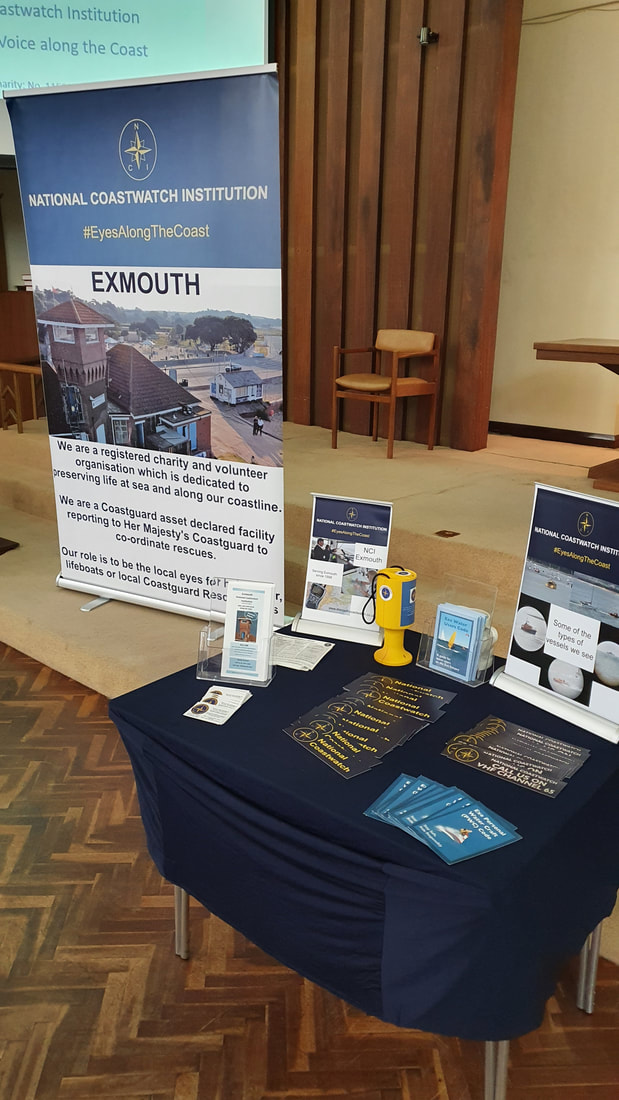
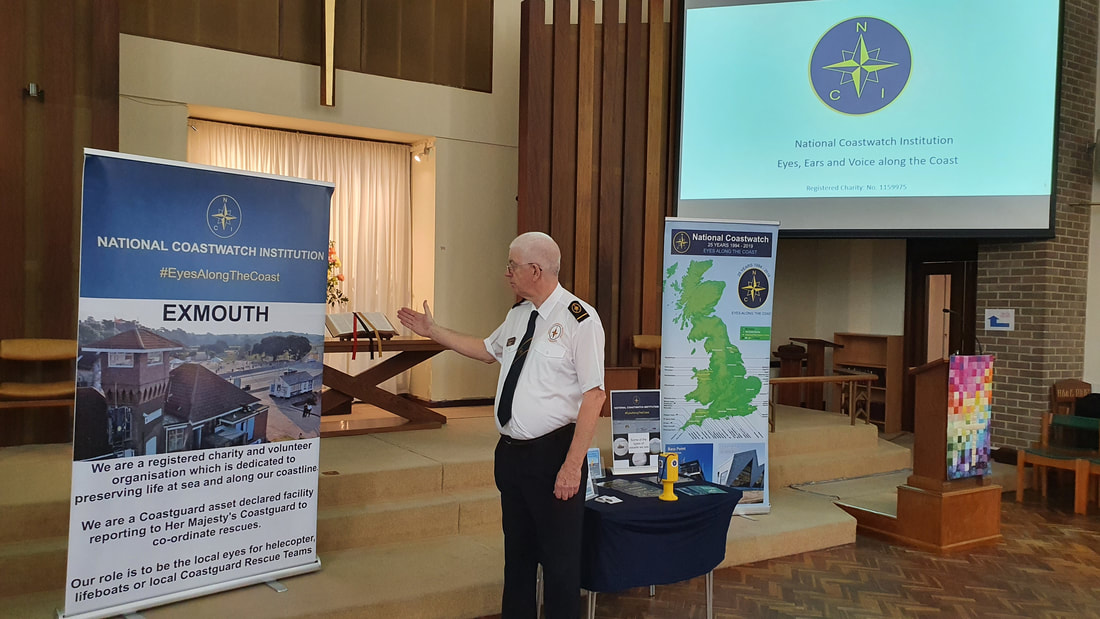
The speakers kindly supplied a couple of photos they had taken just prior to the start of the meeting on 26th January. Sharing those photos seemed worthwhile along with a short report.
The National Coastwatch Institution is, I think, not well known. In part this could be because it is a relatively new body, being formed as a charity only in 1994. Like me you might have thought that coastal safety was adequately covered by the Maritime and Coastguard Agency and the RNLI. However, after the Government of the day decreed the retrenchment of the Coastguard, such that only a very small number of coastal stations remained in operation, there was a fatal marine incident off Cornwall, which, had it been noticed earlier, might have saved the 2 lives lost. By 1994 this tragedy had resulted in the creation of something to fill the gap in physical observations - the National Coastwatch Institution. It is self funded - each station is responsible for finding its own running costs - and the charity receives no money from central Government. Today there are 57 stations dotted around the English and Welsh coasts. Each is manned entirely by volunteers who, after thorough training, maintain a watch from each station during daylight hours throughout the year. The Exmouth station, which occupies the building that used to be manned by the coastguard, is the second busiest in the country and costs some £6000 to run each year. The Exeter Forum is moving into the 21st century, before it transforms into the 22nd century having now set up a Twitter account. The account can be accessed at @ExeterForum.
Why not add a comment to the feed? Better still, why not set yourself up as a follower and stay up-to-date? We have a fascinating range of topics coming up for what we hope will be the last tranche of our Covid-19 induced virtual talks programme.
We will hear an overview of the Jurassic Coast World Heritage Site with insights into its geology and scenery; a history of Mount Batten, Plymouth; an exploration of how art evolved as it depicted the economic and social changes brought about by the Industrial Revolution; and a description of the Commonwealth War Graves Commission, its formation and development, and the conservation and maintenance of its many sites. Exeter Forum's programme of Zoom talks has been firmed up as far as the end of June 2021.
26th May sees a talk by Dr Richard Parker on the historic buildings of English cities illustrated by examples from Exeter's architectural and historic stock. On 9th June Dr Sam Bridgewater of Clinton Devon Estates will examine how habitat decline in the East Devon landscape can be reversed. On 23rd June Paula Clarke, Community Involvement Manager for Castle Drogo, will speak about progress with the restoration of Castle Drogo and about future plans for the restored and waterproof castle. Since the last update, the pandemic-induced temporary programme of Zoom talks has continued. We have heard a talk on the devastation caused by the Fenland Floods of 1947, a talk introducing us to the questions around the evolution of humans and the origins of human consciousness, and a detailed talk on dragonflies and damselflies illustrated by some brilliant photographs.
Following the publication of the Government's roadmap out of lockdown, it is now evident we will not be permitted to restart our normal weekly meetings at the Mint for several months to come. As a consequence the programme of fortnightly Zoom talks is being extended. On 17th March we will be hearing a talk on unusual weather phenomena with particular reference to those experienced here in Devon. Following that we will have a talk about running the length of South America, a talk about activities and developments at Exeter Cathedral, and a talk about bird migration. After this programme there is to be a virtual AGM. Subsequent to this there was to have been a talk about Dartmoor legends. That has had to be cancelled, but in its place there will be a talk by Dr Todd Gray on Exeter's Georgian Cloth Industry. After this there will be a talk on the Urban and Suburban Architecture in an Ancient English City -Exeter. Since the first Forum Zoom talk was held on November 25 last year, another three talks have been presented. First we heard a talk about the sailing ship HMS Terror and its voyages to the Polar regions. Next, members and guests were treated to a talk about the unicorn in art and heraldry, and most recently, we heard a talk about the rise and fall of English seaside resorts between 1750 and present time. Audience numbers for these talks has been increasing steadily as more members become confident about using Zoom and so Forum has a further programme of talks planned. So far four have been booked. These will be held at at fortnightly intervals and will take us up to mid-March. The subjects to be covered include: the Fenland floods of 1947, dragonflies and damselflies and unusual weather phenomena. A continuation of virtual talks beyond 17 March will depend on the progress of the pandemic and when Forum will be allowed to revert to physical meetings. During the course of the Covid 19 pandemic members have missed the social contact and mental stimulation that Forum normally provides. This led those members of the committee who had since the lockdowns started become familiar with the world of Zoom calls, deciding to try out one or two meetings for Forum members using the app.
Firstly, a virtual meeting of the committee was attempted. This was successful in getting most members up to speed with Zoom. There then followed an informal session for all interested members, the main purpose of which was to help members familiarise themselves with Zoom's idiosyncrasies. Subsequently, on 25th November, we held the first meeting of Exeter Forum by Zoom that included a talk. In all some 30 members participated. The first 15 mins was devoted to ensuring that all could view the meeting and that they could be heard. Chairman David Oates then presented a talk on "Land of Lakes and Leprechauns: the Hidden Secrets of South West Ireland". This lasted for 45 mins after which there was a 15 min Q & A session. In addition to showing the natural beauty of this secluded and mysterious part of Ireland, David included details of some of the interesting places and artefacts in this area, and retold some of the background stories. The morning's interaction was brought to an end by an informal discussion on general Forum matters for about half an hour. Unlike meetings at the Mint we do not have to finish Zoom meetings by a set time and so have more flexibility to allow for general discussions and comment besides the main topic of the morning. More Zoom meetings will follow. Recently Forum members heard a talk given by the manager of the Exeter Food Bank, Mark Richardson. A number of perhaps misrepresented facts came out of his presentation. Firstly, instead of being skivers and scroungers, most, if not all, food bank applicants are working or are carers. Secondly, you cannot claim food bank donations simply by walking along to the premises and knocking on their door. Contrary to the impression conveyed by the tabloid media, you must first have been vetted by one of the referral agencies involved in social care. These include the Citizens Advice Bureaux, council housing support officers, children’s centres, GPs and health visitors, social services and some local charities. After they have vetted you, you are given a referral voucher which you take with you to the Food Bank. This they then exchange for 3 days' supply of food.
In 2018/19 the Exeter Food Bank provided over 6800 food parcels (or some 78000 kg of non-perishable food), over 2000 of which went to children. That is an average of over 130 parcels a week. Nationally over 1.6 million parcels were given out last year. But unfortunately demand for the service is increasing. The demand in 2018 was 23% higher than the previous year. And in the first three months of this year the run rate of food bank parcels given out has risen by another 31%. Much of the rising demand for parcels appears to have been caused by the introduction of the Universal Credit scheme and the requirement for those moving on to it to have their benefit payments held back for 6 weeks. While, in response to criticism the government did reduce the 6 week wait to 5 weeks. that is still too long for those without any savings to survive without any income, and so the demand for food banks continues to rise. It is difficult to avoid the conclusion that many of those forced to use food banks are honest, hard-working people doing their best to get by, but are doing low paid jobs that do not pay enough on their own to give a tolerable standard of living. Yet that delay before the receipt of benefits is a built-in feature of the new system despite the hardship it causes. Quite how this state of affairs is allowed to persist in the 21st century in a country which has the sixth largest economy in the world is difficult to fathom. One might be forgiven for thinking that this is unacceptable in what is one of the wealthiest countries in the world. Yet it is difficult to see conditions improving materially soon to the point that food banks will no longer be needed. Unfortunately, Mark's stated ambition of putting himself out of work appears unlikely to be realised any time soon. Recently a group of Forum members had a guided tour of the Theatre Royal, Plymouth. The tour guides were two volunteers from a theatre support group, one of whom had been a professional dancer.
The tour started with a brief history of theatres in Plymouth and of the building of the current theatre, which was designed by Peter Moro and completed 1982, when it was opened by HRH Princess Margaret. The theatre was built by Plymouth Council and one of the first questions asked by Peter Moro was what size of theatre did they want and as the Council had not come to any firm decision on size they asked what he would suggest. He responded by suggesting a 1300 seat auditorium, probably influenced by his experience in designing theatres such as the Festival Hall in London, serving an area with a much larger population than Plymouth. As it was unlikely that a 1300 seat theatre in Plymouth would be full very often and in order to avoid performers having to be faced with large areas of empty seats, Peter Moro developed a radical design having the ceiling and top floor of seats mounted on an hydraulic system of supports, thereby enabling the size of the auditorium to be 1300 seats or 800 seats depending on the show and the expected size of audience. We were guided through the maze of corridors and rooms behind and below the stage area. The corridors are surprisingly narrow, with hardly room for two people to pass each other. It is thus difficult to see how they cope with productions involving performers dressed in large costumes and full skirted women's dresses. The walls and ceilings have no covering over the bare concrete used to construct it, which gave it the feel of the underground prisons often portrayed in films, in total contrast to the magical scenes being produced for the audience. We were shown one of the dressing rooms used by supporting cast members. This was just as bleak, although we were assured the stars of the show had more comfortable dressing rooms, some of them even including an en-suite shower room. It was pointed out that although the accommodation appeared spartan, it was a great improvement on the facilities in many of the older theatres. In addition to the Lyric, the main auditorium, we were shown the Drum, a more intimate 200 seat auditorium which is used mainly for new plays and collaborations with small production companies. In 2013 an hospitality area was converted into a 50 seat community performance space called the Lab where we met three young people working on a project, with a stuffed fox sitting in the Directors chair! We were then shown the area underneath the main stage. Here there is machinery to raise and lower an area for an orchestra which had required cutting a pit through solid rock. The pit floods when there are exceptionally high tides! When being shown the main Lyric auditorium we were lucky to have the opportunity of seeing the warming up and practice procedure of a group of acrobats who were in the Cirque Macabre show, and met a group of South American stunt motor cyclists in the same show. The 90-minute tour was excellent in showing the complexity of all the background work involved in providing a wide variety of live entertainment of a very high standard. All in all it was a very interesting visit. |
Archives
October 2025
|
RSS Feed